
How do unemployment insurance and retirement benefits help us explain age variation in the cost of job loss?
Based on research by Frank Leenders and Johanna Wallenius
Over the last several decades, it has been established that job loss is associated with large and persistent earnings losses on average, across a wide variety of settings and locations (see, e.g., Jacobson et al, 1993; Bertheau et al, 2023; Schmieder et al, 2023). One might imagine that these losses are even larger for workers who lose their job later in their working lives. After all, older workers tend to have more trouble finding a new job. For this reason, older workers tend to be eligible for unemployment insurance (UI) benefits for longer periods, which in turn may also affect their overall earnings losses. In addition, as workers lose their jobs closer to their (planned) retirement age, the earnings loss is likely to be affected by changes in their retirement timing. As such, we expect the design of the social insurance system to not only affect retirement timing in general (as shown in Erosa et al, 2012; Laun and Wallenius, 2016), but also how workers are affected by a job loss. In ongoing work, we examine the extent to which age dependencies in the social insurance system explain variation in the cost of job loss across ages.
To answer this question, we first turn to German administrative data, specifically the Sample of Integrated Labor Market Biographies (SIAB), as described in detail in Antoni et al (2019). Using data from 2005 to 2017 for male workers, we estimate the cost of job loss by worker age (at the time of the job loss). We do so by estimating an event study separately for each age, using the method proposed by Borusyak et al (2024). In this empirical exercise, we consider only workers whose job loss is likely to have been part of a mass layoff (displacement), so that the job loss is unlikely to be directly related to the worker’s own performance.
We find that the earnings losses following such a displacement generally increase with age. This is true for both the short-run impact (measured 1 year after the displacement) and the longer-run impact (measured 5 years after the displacement). In particular, the relative earnings losses in the short run increase from 24%, for workers displaced at age 30, to 37%, for workers displaced at age 55, whereas the losses after 5 years increase from 15% to 35% between these same two ages. These increasing earnings losses are in line with the existing literature (e.g. Salvanes et al, 2024). For employment, we find a similar increase in age throughout most of the working life. However, we see a reversal for older workers, with the effect of displacement on employment decreasing in age for workers aged around 60, suggesting that these workers tend to retire later than planned after losing their job late in their working life.
To quantify the extent to which these life-cycle patterns of earnings and employment losses are affected by the social insurance system, we develop a life-cycle model. In this model, we include elements that have been shown in previous work (e.g. Jung and Kuhn (2019); Jarosch, 2023) to be successful in explaining the average cost of job loss, such as search frictions, a job ladder, and human capital (de-)accumulation. In addition, we allow workers to choose their retirement age, and include a detailed representation of the social insurance system. In particular, a worker’s retirement benefit depends on their entire working history, with an additional adjustment if they retire earlier or later than the regular retirement age of 65. Furthermore, while UI benefits generally depend on the worker’s most recent earnings from employment, the duration for which the worker receives these benefits is age-dependent, slowly increasing from 4 quarters at ages below 50 to 8 quarters at ages 58 and above. Finally, workers who are not eligible (anymore) for UI benefits may still qualify for a means-tested welfare benefit.
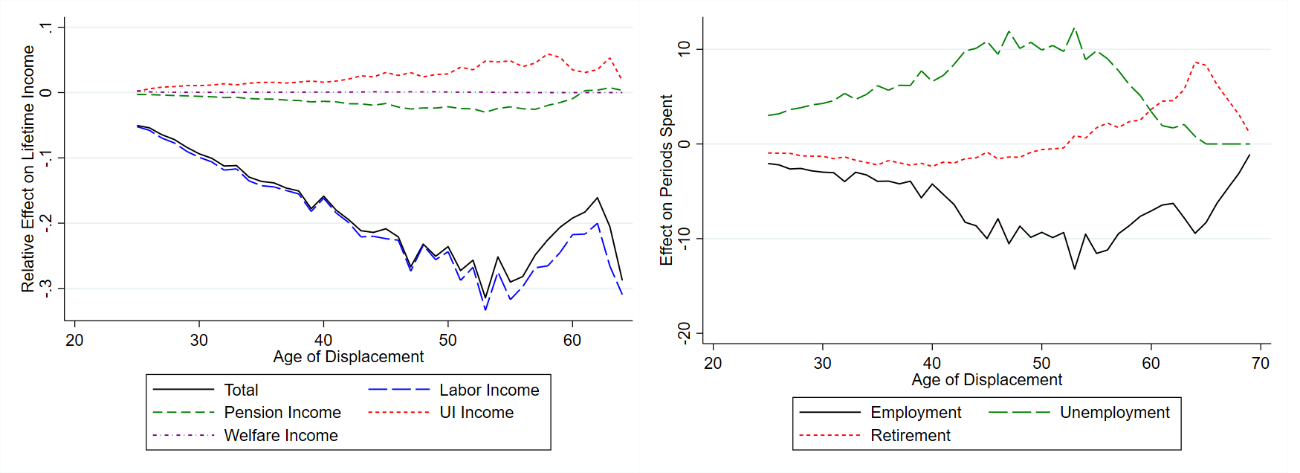
Figure 1: The age-specific effect of displacement on the present value of relative (remaining) lifetime income (left) and on the change in years spent in each worker state (right), by source.
Using the estimated model, we decompose the effects of job loss on remaining lifetime income (discounted to the age of job loss) and remaining years in employment into their sources. As seen in the left panel of Figure 1, the effect on remaining lifetime income is dominated by the effect on earnings from employment (which was what we measured in the data) for most of the working life. Further decomposition reveals that much of the increase in the earnings loss up to age 50 can be attributed to the sharply decreasing job finding rate. For job losses after the age of 50, the impact of age dependencies in UI duration, as well as the upcoming retirement decision, becomes increasingly important. Naturally, this is in part a mechanical effect: even if we keep the retirement age and time spent in unemployment fixed, the fraction of the remaining lifetime spent in retirement and unemployment increases as the worker ages. However, we also observe that the worker, on average, spends more time in both unemployment and retirement if they lose their job at a later age, as seen in the right panel of Figure 1. In particular, this implies that workers tend to retire earlier (on average) if they lose their job at an older age. In contrast, workers who lose their jobs earlier in their working lives tend to retire later.
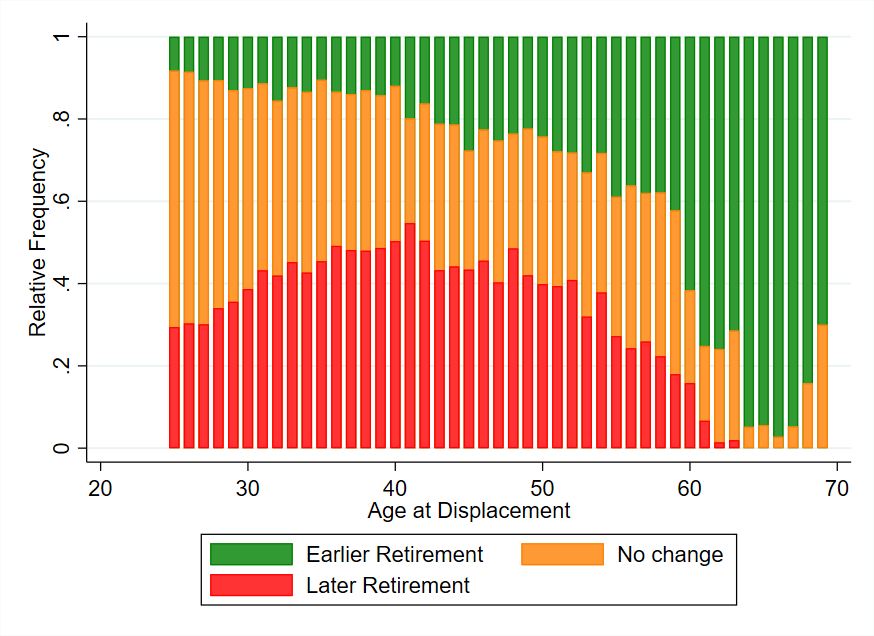
Figure 2: Frequency of workers retiring later or earlier in response to a displacement in the model simulation, relative to the (age-specific) number of displaced workers, by age at displacement.
Further investigating the effect of job loss on retirement timing, we uncover substantial heterogeneity in this effect. This is evident in Figure 2, which shows that for most ages of displacement, a large fraction of workers retires earlier than planned, but also a sizeable fraction of workers retires later than planned.
The heterogeneous patterns in retirement timing (and their response to job loss) can be explained by two opposing forces. First, when the worker decides whether to retire, they compare current earnings in employment to income in retirement (assuming immediate retirement). When a worker loses their job, their current earnings in employment decline sharply, as they earn much less in their first job after the job loss (assuming they find one) than in the job they lost. This makes the retirement more attractive. Therefore, this channel explains why workers may want to retire earlier.
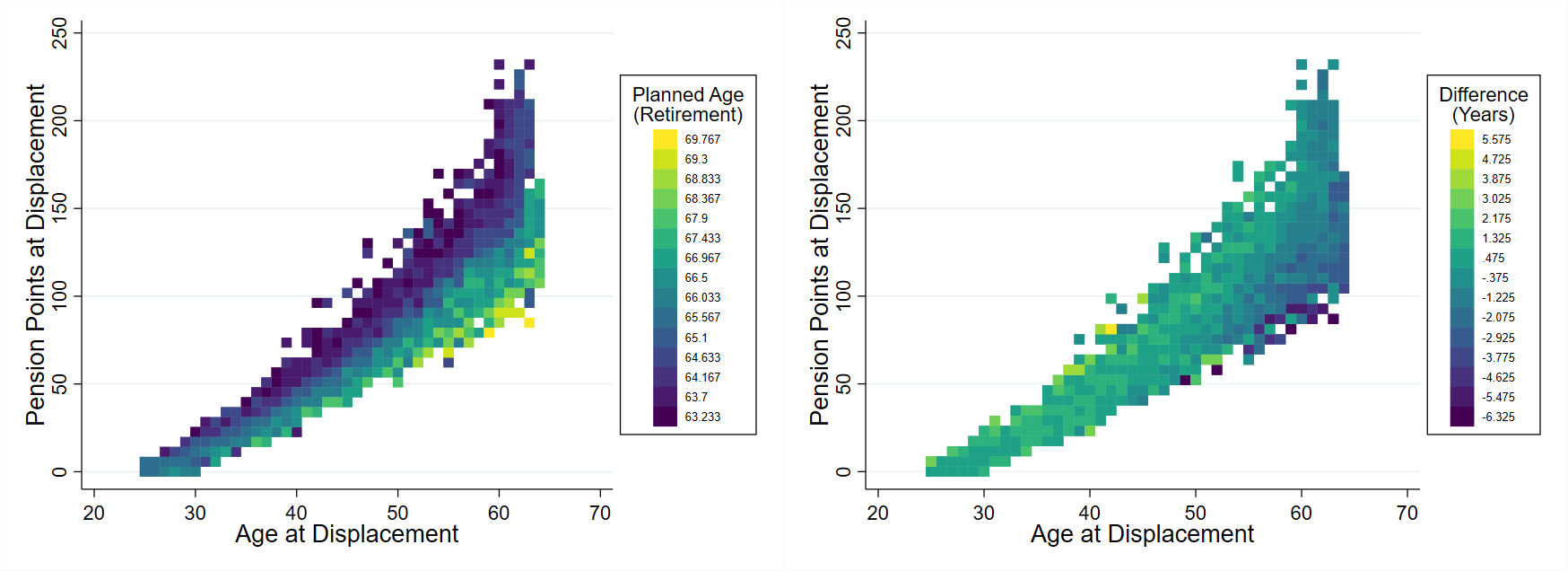
Figure 3: Average planned retirement age (left) and change in retirement timing upon displacement (right) in the model simulation, conditional on a nonzero change, by age and pension points at displacement.
The channel going in the opposite direction acts through savings. In the absence of job loss, the savings (which are highly correlated with lifetime income and accumulated pensions) act as a vehicle through which workers can compensate for the penalty that they incur on their retirement benefit if they decide to retire earlier, which they would like to do in order to avoid the disutility of work. For this reason, we generally observe that workers with higher lifetime income retire earlier, as illustrated in the left panel of Figure 3, which plots the planned retirement age (in the absence of the job loss) by age and accumulated pensions (as a proxy for lifetime income) at the time of the job loss. When workers lose their jobs, they also use their savings to compensate for the lost income during (and after) the subsequent unemployment spell. As a consequence, these workers reach the early retirement age with less savings, and may therefore postpone retirement. This savings channel is particularly important for workers with higher lifetime income, whereas the aforementioned earnings channel is more important for workers with low income. This results in the heterogeneous effect of job loss on retirement timing depicted in the right panel of Figure 3.
Overall, we find that the age dependencies in the social insurance system substantially affect the consequences of job loss. This holds for workers of all ages, not just those close to retirement, suggesting that policies aiming at alleviating the adverse effects of job loss should account for how these policies may affect workers’ retirement decisions in the years ahead.
About the Authors:
Frank Leenders is a Postdoctoral Researcher (ATRAE) at Universidad Carlos III de Madrid. He works on macroeconomics and labor economics.
https://frank-leenders.github.io/
Johanna Wallenius is the Ragnar Söderberg Chair in Economics and a Full Professor at the Stockholm School of Economics. She is also a CEPR Research Fellow and a Wallenberg Academy Fellow. She works on macroeconomics, labor economics, and household economics.
Further Reading:
Leenders, F., and Wallenius, J. (2024), “Social Security and Life-Cycle Variation in the Cost of Job Loss”, CEPR Discussion Paper No. 18983. CEPR Press, Paris & London. https://cepr.org/publications/dp18983
A more recent version is available at https://frank-leenders.github.io/LW_LCScar.pdf
References:
Antoni, M., vom Berge, P., Graf, T., Griessemer, S., Kaimer, S., Köhler, M., Lehnert, C., Oertel, M., Schmucker, A., Seth, S., and Seysen, C. (2019). “Weakly anonymous Version of the Sample of Integrated Labour Market Biographies (SIAB) – Version 7517 v1”. Research Data Centre of the Federal Employment Agency (BA) at the Institute for Employment Research (IAB). DOI: 10.5164/IAB.SIAB7517.de.en.v1.
Bertheau, A., Acabbi, E. M., Barcelo, C., Gulyas, A., Lombardi, S., and Saggio, R. (2023). “The unequal cost of job loss across countries”. American Economic Review: Insights, 5(3):393–408.
Borusyak, K., Jaravel, X., and Spiess, J. (2024). “Revisiting event study designs: Robust and efficient estimation”. The Review of Economic Studies, 91(6):3253–3285.
Erosa, A., Fuster, L., and Kambourov, G. (2012). “Labor supply and government programs: A cross-country analysis”. Journal of Monetary Economics, 59:84–107.
Jacobson, L. S., LaLonde, R. J., and Sullivan, D. G. (1993). “Earnings losses of displaced workers”. The American Economic Review, 83(4):685–709.
Jarosch, G. (2023). “Searching for job security and the consequences of job loss”. Econometrica, 91(3):903–942.
Jung, P. and Kuhn, M. (2019). “Earnings losses and labor mobility over the life cycle”. Journal of the European Economic Association, 17(3):678–724.
Laun, T. and Wallenius, J. (2016). “Social insurance and retirement: A cross-country perspective”. Review of Economic Dynamics, 22:72–92.
Salvanes, K. S., Willage, B., and Willen, A. (2024). “The effect of labor market shocks across the life cycle”. Journal of Labor Economics, 42(1):121–160.
Schmieder, J. F., von Wachter, T., and Heining, J. (2023). “The costs of job displacement over the business cycle and its sources: Evidence from Germany”. American Economic Review, 113(5):1208–1254.